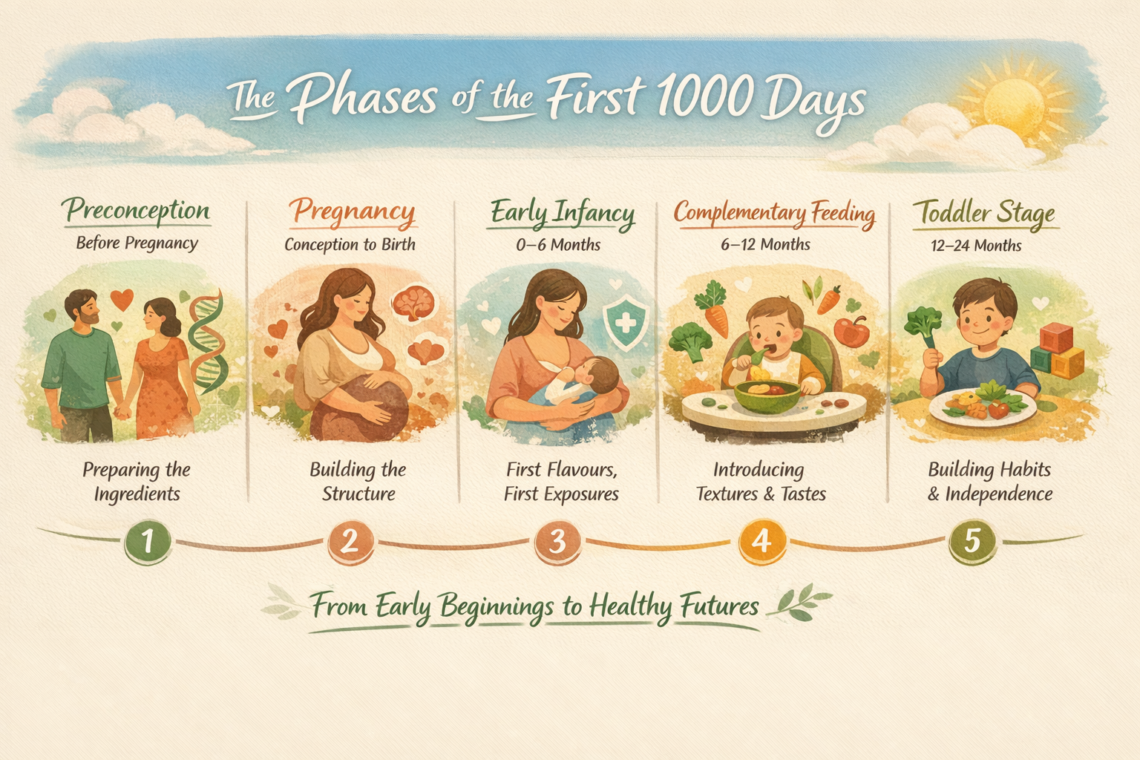
From the moment of conception to around your child’s second birthday, the body goes through an extraordinary period of growth and development. This window, known as the first 1000 days, is where the foundations for lifelong health are built. During this time nutrition is powerful, and often underestimated.
We are talking about:
- fetal brain development
- immune system
- strength metabolism
- child’s future eating habits
- gut health and microbiome development
- risk of future chronic diseases later in life
Before your baby ever tastes food, their future relationship with it is already being shaped.
The global focus on the first 1000 days began to gain momentum in the early 2000s, when researchers and public health organisations started to more clearly connect early-life nutrition with long-term health outcomes. A key turning point came through the work of David Barker, a British epidemiologist who demonstrated that conditions during early development, particularly in utero and early infancy, can influence the risk of chronic disease later in life.
This led to the development of the Developmental Origins of Health and Disease (DOHaD) framework, which fundamentally shifted how we understand health: not as something that begins in adulthood, but as a process that is shaped from the earliest stages of life. Rather than being reactive, health is now understood as something that is “programmed” early on by nutrition, environment, and developmental exposures. This growing body of evidence has been widely recognised and supported by global health organisations such as the World Health Organization and UNICEF.
Later, global initiatives such as 1,000 Days helped translate this scientific evidence into public health messaging, raising awareness of how this critical window influences not only individual health outcomes, but also population-level wellbeing.
Why the First 1000 Days Matter
Think of this period as preparing a long, slow-cooked dish.
It cannot be rushed at the end.
And once the structure is set, you cannot simply “fix” it later with quick adjustments.
What you choose at the beginning, the quality of inputs, the timing, and the consistency, quietly shapes the final outcome in ways that are difficult to reverse.
In the same way, early nutrition helps shape:
- how a child learns to accept and enjoy food
- their long-term risk of developing chronic diseases
- their ability to regulate hunger and fullness
- and their relationship with eating as they grow
This does not mean perfection is required. Far from it, but it does mean that small, consistent choices made over time carry far more weight than we often realise.
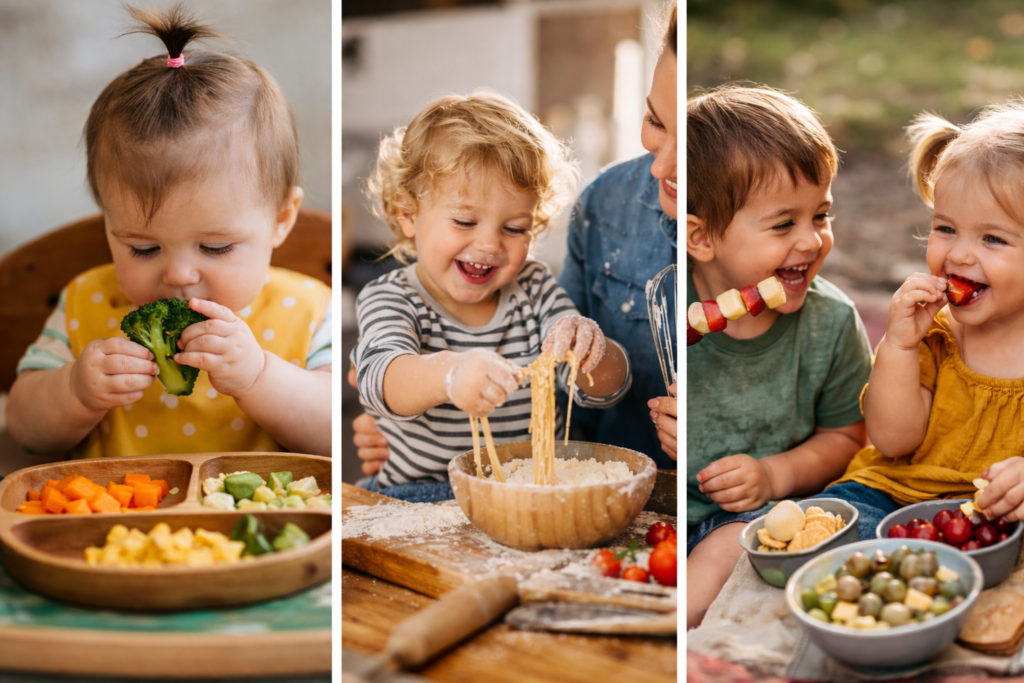
What I Experienced… and What Was Missing!
When I was pregnant, I realised something very clearly.
We are all given the same general advice: no raw food, now alcohol, limit caffeine, no this and no that. I was given a brochure and a government website to check, and that was it! No personalised plan, no real follow-up, no practical guidance on what to eat, how to eat, or when to eat in a way that actually fits daily life.
Even though I had spent almost a decade working as a chef, surrounded by food, ingredients, and daily cooking, when it came to nourishing myself during pregnancy,
I didn’t have a clear idea of what to do. And that surprised me because if someone with my background felt uncertain, how are most parents expected to feel?
No one asked deeper questions like:
- Do you need more of certain nutrients?
- How is your digestion?
- What does your gut health look like?
And something that struck me even more… No one asked about the father.
His nutrition, his lifestyle, his health, all of which play a role in conception and early development, were completely absent from the conversations.
This is when I started to realise that what families are missing is not information, it is practical, personalised, and grounded in real life guidance.
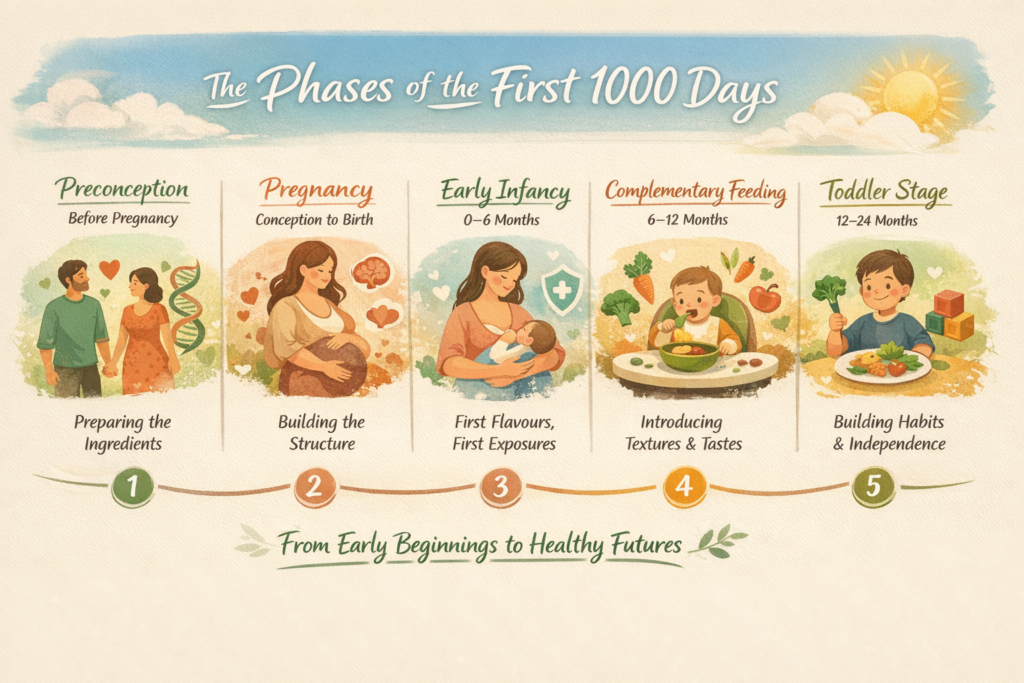
The Phases of the First 1000 Days
The first 1000 days are not one single moment, but a series of connected stages, each with its own role in shaping a child’s health. Like a recipe, every phase builds on the one before it.
Each of these phases is a world of its own, and we will take the time to explore them, one bite at a time! In the next articles, I will guide you through each stage more deeply, with practical advice, simple strategies, and recipes inspired by everyday Italian-Mediterranean cooking.
This is just the beginning.
1. Preconception (Before Pregnancy)
Preparing the ingredients: This phase begins even before pregnancy occurs.
During this time, the health and nutritional status of both parents help shape:
- fertility
- egg and sperm quality
- early embryo development
Nutrient stores, lifestyle habits, stress levels, and metabolic health all contribute to creating the environment in which new life begins. This is where foundational habits, balanced meals, whole foods, and adequate nutrients, quietly set the stage.
2. Pregnancy (Conception to Birth)
Building the structure: Pregnancy is a period of rapid growth and development, where nutrition provides the essential building blocks for:
- organ and tissue development
- brain and nervous system development
- immune system formation
- placental growth and function
- maternal health and physiological adaptation
Each trimester brings slightly different needs, but the overall goal remains the same: consistent, balanced nourishment that supports both mother and baby.
Nutrition during pregnancy also plays a crucial role in supporting the mother’s health, helping to reduce the risk of complications such as gestational diabetes, hypertensive disorders (including preeclampsia), and excessive or inadequate weight gain. During this time, nutrition doesn’t just support growth, it helps shape long-term health outcomes for both mother and child.
3. Early Infancy (0–6 Months)
First flavours, first exposures: In the early months, feeding continues to shape development.
The first three months after birth, often referred to as the “fourth trimester”, are a period of recovery, adjustment, and deep physiological change for the mother.
Breast milk, in particular, reflects the mother’s diet and provides:
- essential nutrients
- immune factors
- early exposure to different flavours
This is where babies begin their first sensory experiences with food, even before solids are introduced. Nutrition during Early Infancy is not only about feeding the baby, but also about helping the mother regain strength, support healing, milk production, and maintain stable energy levels during a physically and emotionally demanding time. During this stage, the focus is often placed entirely on the mother and baby, but the wider family environment plays an important role as well.
4. Complementary Feeding (Around 6–12 Months)
Introducing textures and tastes: This is the phase where babies begin eating solid foods alongside breast milk or formula, gradually transitioning from a milk-based diet to a more varied and complex way of eating. But this stage is not only about meeting nutritional needs, it is also a critical period of learning.
During this time, babies begin to develop:
- taste preferences
- acceptance of different textures
- oral motor skills involved in chewing and swallowing
- early eating behaviours and responses to food
Repeated exposure to a variety of foods, especially vegetables, whole foods, and balanced meals, plays a key role in shaping future eating habits. Importantly, this is not about perfection or rigid approaches, but about creating a positive and responsive feeding environment, where babies are guided, not forced, in their exploration of food.
5. Toddler Stage (12–24 Months)
Building habits: As children grow, they begin to eat more independently and develop stronger preferences, both for certain foods and for how meals are experienced. At this stage, the focus shifts from introducing foods to building habits.
This includes:
- reinforcing variety through repeated exposure
- creating structure and routine around meals and snacks
- modelling healthy eating behaviours within the family environment
- encouraging autonomy, while maintaining guidance
It is also during this phase that picky eating can begin to emerge, a normal part of development, but often a challenging one for parents. This is where consistency, patience, and a calm, pressure-free feeding environment become essential.
Rather than focusing on immediate intake, the goal is to build trust, familiarity, and a positive relationship with food over time.
The first 1000 days are not about perfection.
They are about building a foundation, across each phase, from preconception to toddlerhood. Small, everyday choices come together to shape something much bigger: not only how a child grows, but how they experience food, health, and wellbeing throughout their entire life.
Because at the end is not about feeding a child, is about raising happy healthy eaters one bite at a time!
Follow along for weekly tips, practical guidance, and simple recipes to support you through every stage of the first 1000 days.
Thank you for reading and for being part of the Little Brave Celery family, Ciao!
