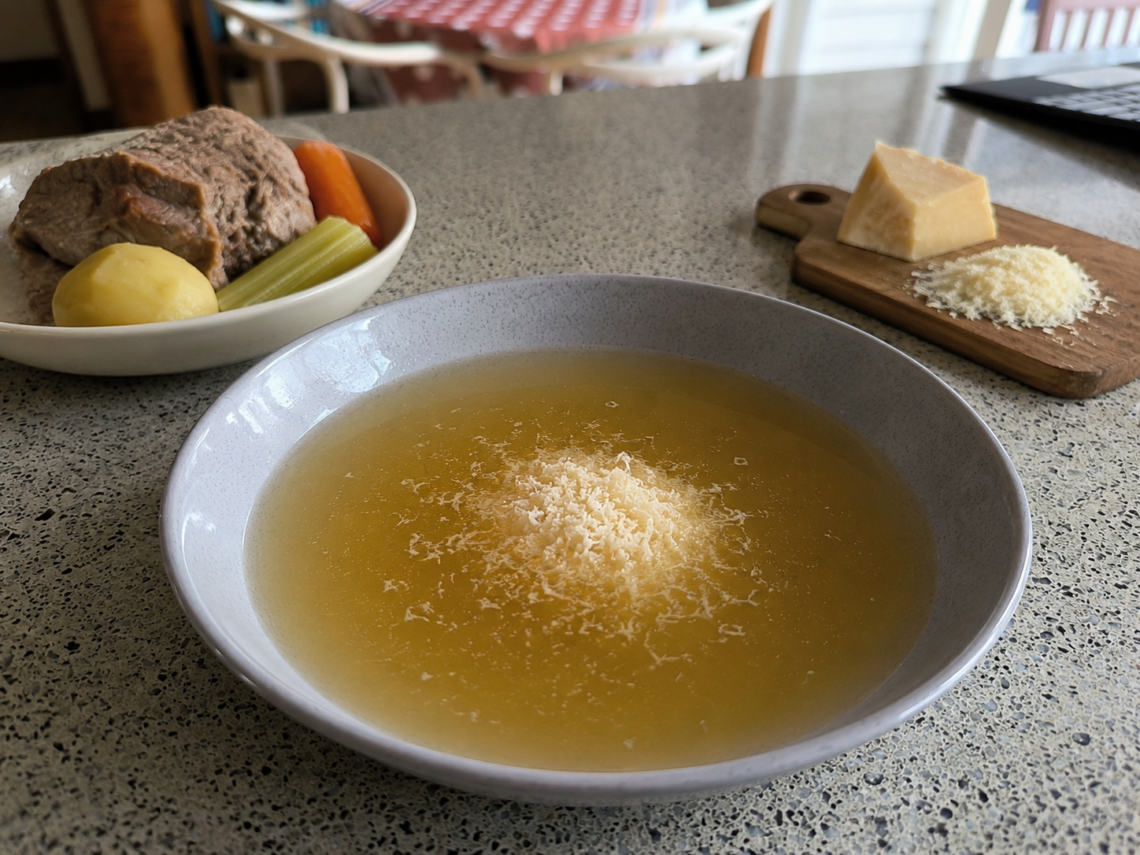
Brodo di Carne
There is something almost impossible to explain about a real homemade broth.
The smell alone can change the feeling of an entire house: meat, bones, onion, carrot, and celery slowly simmering while steam fogs the kitchen windows and everything outside feels cold and grey
In the homes where I grew up, especially during winter in Piacenza, there was almost always a pot of brodo quietly bubbling on the stove. It was never considered something special or luxurious, but simply part of everyday life, the beginning of countless meals and moments of care. Time slowly draws flavour, nutrients, and richness from the simplest ingredients, transforming them into something simple and restorative. Maybe this is what our grandmothers understood so well: that some of the best foods simply ask us to slow down, wait patiently, and let care quietly simmer in the background.
A History Older than Recipes Themselves
Broth is probably one of the oldest cooked foods humanity has ever made.
Historians believe that as soon as humans began placing pots over fire, some form of broth likely appeared alongside it. The simple act of simmering bones, meat, herbs, roots, and vegetables in water allowed people to soften tough ingredients, extract flavour, and create meals capable of feeding many people from relatively little food. In many ways, broth may have been one of humanity’s very first slow-cooked foods.
Versions of broth already existed throughout Ancient Greece and the Roman Empire, where soups and meat broths were considered nourishing, restorative, and practical everyday food. Different ingredients and different traditions, but often the same instinct to nourish gently.
Over time, broth became deeply connected to cucina povera and family life across Italy and the Mediterranean. Nothing was wasted, and like almost every traditional recipe, there was never one single “correct” version. Every family, every nonna, every house had its own way of preparing broth, shaped by what was available, seasonal, affordable, or simply preferred. Some used beef, others chicken or gallina, some added pork bones for extra richness, while the vegetables changed from kitchen to kitchen: onion, celery, carrot, potatoes, tomatoes, parsley, or whatever happened to be growing in the garden at that moment.
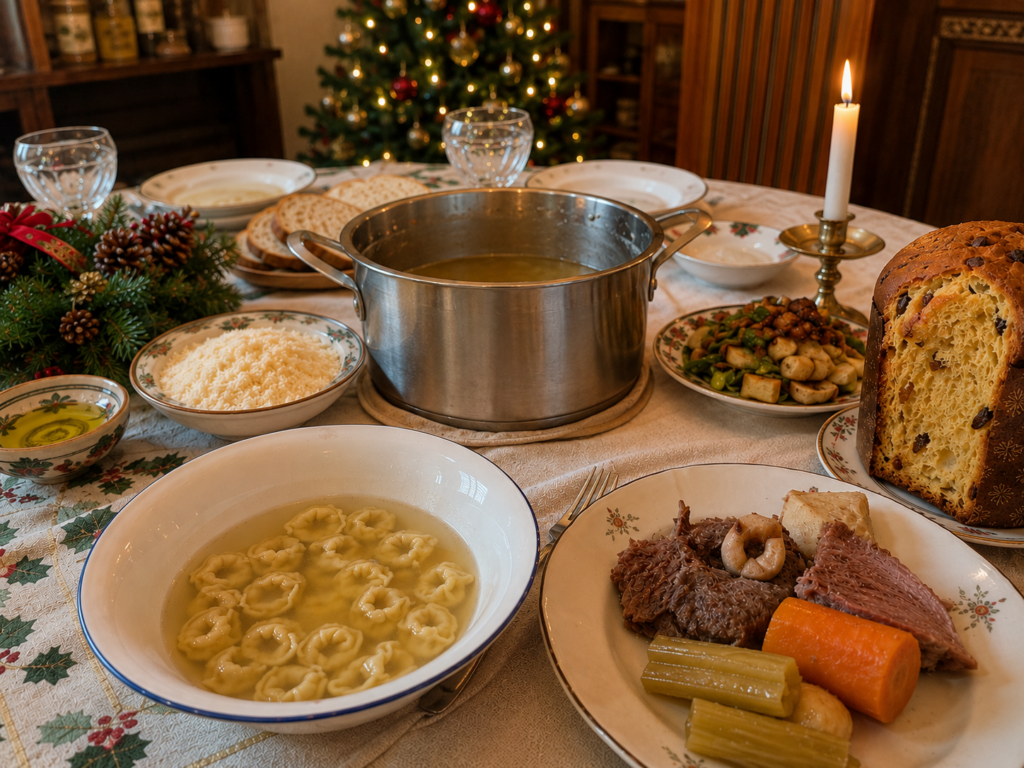
During important celebrations, especially Christmas, broth often became richer and more elaborate. Families would prepare it using more prized cuts of meat and, very often, cappone, a capon traditionally valued for its tender meat and rich flavour, slowly simmered for hours to create a deeply golden broth reserved for festive meals and large family gatherings.
In many parts of Northern Italy, including the area where I grew up, this broth became the foundation for traditional filled pastas such as anolini, tortellini, and other delicate pasta shapes served directly in the broth itself. And honestly, few things feel more deeply connected to Italian winter traditions than a steaming bowl of handmade pasta floating in rich broth. But the broth itself was never the only nourishment coming from the pot. The meat used to prepare it often became a second meal entirely, served after the broth and the pasta cooked inside it.
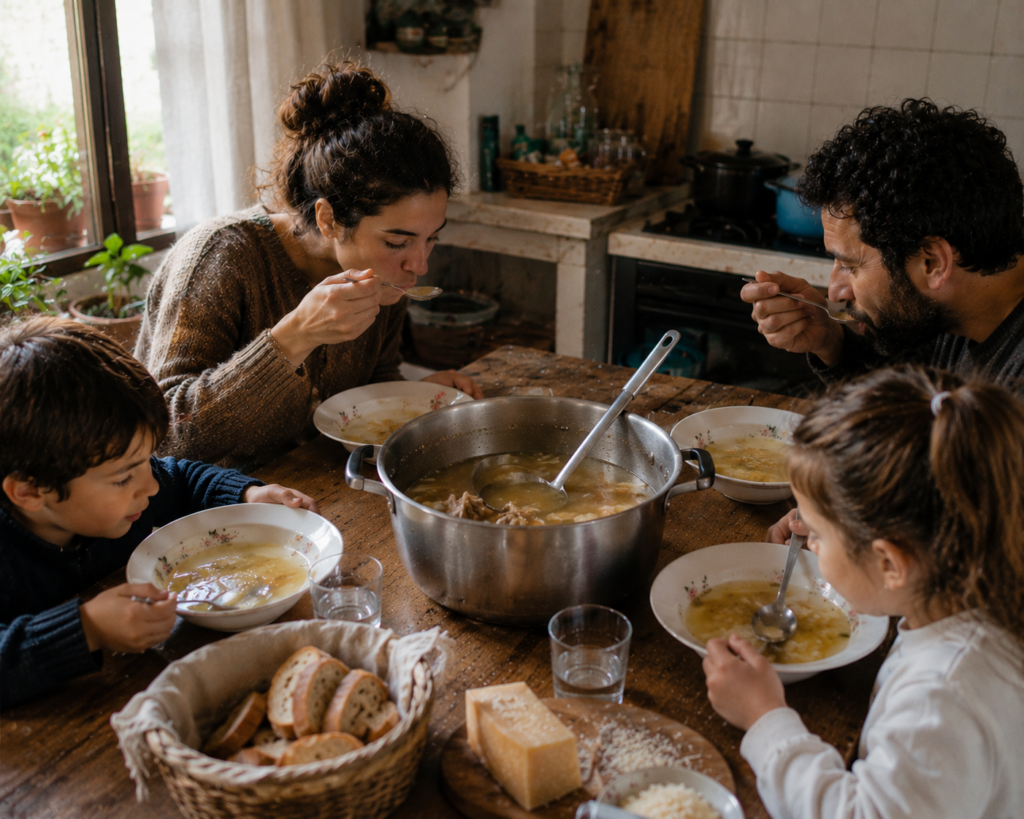
In many Northern Italian homes, especially during winter, this was a very common family meal: first a warm bowl of broth with tiny pasta or filled pasta, followed by the slowly simmered meats served as secondo alongside the same vegetables from the broth, traditional sauces, or seasonal side dishes. One pot quietly became multiple meals capable of feeding an entire family across several days.
The Science Behind the Simmer
Although broth often appears simple, there is actually a great deal happening quietly during the slow cooking process. As meat, bones, connective tissues, and vegetables simmer gently over time, water slowly draws out minerals, amino acids, gelatine, fats, flavour compounds, and nutrients from the ingredients themselves. This gradual extraction gives broth both its nutritional value and its deep flavour. Depending on the ingredients used, meat and bone broths may provide hydration, sodium and electrolytes, small amounts of protein, collagen-derived compounds, and minerals such as potassium and phosphorus, while the vegetables contribute additional nutrients and aromatic compounds of their own.
Part of broth’s strength lies not only in what it contains nutritionally, but also in how naturally gentle it feels on the body. Warm broth is often easy to tolerate during illness, periods of low appetite, childhood sickness, pregnancy, or postpartum recovery, offering nourishment in a form that feels soft, light, and restorative rather than heavy or overwhelming.
For babies, broth often becomes one of the first flavours beyond milk itself, forming the base of their first “real food” meals. In Italy, broth has traditionally played a central role in the early stages of weaning. For generations, one of the first meals offered to babies was a simple bowl of brodo combined with semolina, or rice flour, or polenta, or tiny pasta shapes, and often finished with a sprinkle of Parmigiano and extra virgin olive oil. These soft meals were often enriched with a spoonful of vegetable, meat, fish, or legume omogeneizzato, creating smooth, gentle textures suitable for little ones just beginning their food journey.
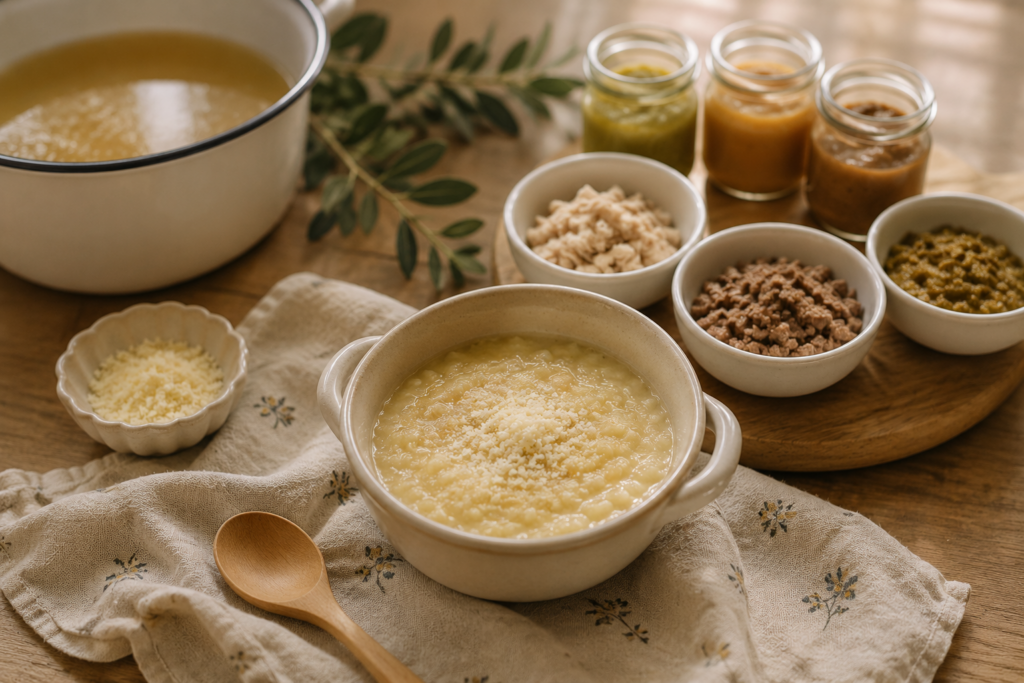
Many Italian adults today grew up with these simple minestrine as some of their very first foods. Although approaches to introducing solids vary greatly today, broth remains deeply woven into memories of childhood, comfort, and care. Perhaps this is also why so many Italian parents and grandparents instinctively turn to broth when little ones are unwell. Not because it is a medicine, but because generations have trusted its warmth, simplicity, and gentleness during difficult moments.
I was reminded of this when my son caught hand, foot, and mouth disease for the first time around seven or eight months old. His tiny mouth was covered in painful sores, and eating suddenly became incredibly difficult for him. During those days, he mostly wanted milk and broth. Warm spoonfuls of broth became one of the few things he could comfortably tolerate while still helping him stay hydrated and nourished.
Perhaps that experience stayed with me because it connected two generations at once. I was preparing the same kind of simple broth that many Italian parents and grandparents have prepared for babies for decades. When making it for little ones, I usually keep it very simple and delicate: a small piece of veal or chicken gently simmered with carrots, celery, a potato, and a little onion in plenty of water, without added salt.
That experience reminded me that food does not always need to be elaborate to matter. Sometimes the most important meals are simply the ones a body can accept during difficult moments.
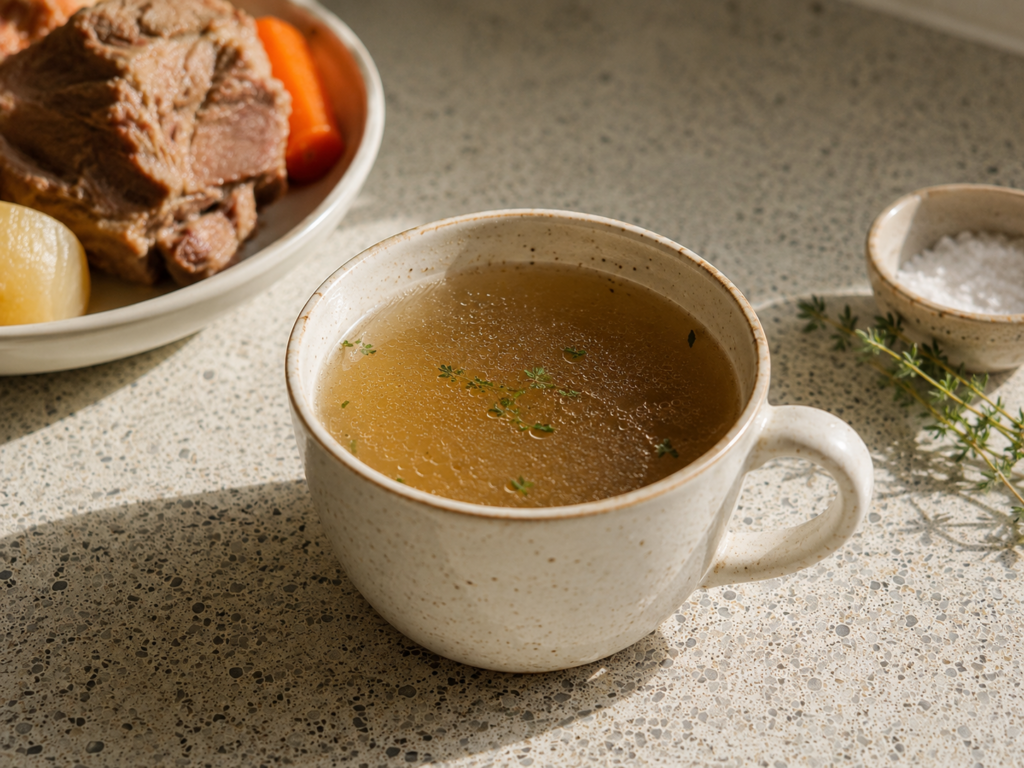
Slow Nourishment for Modern Life
One of the beautiful things about broth is that although it belongs to very old traditions, it still fits surprisingly well into modern family life. A large pot of broth can feed multiple meals, freeze beautifully, become the base for endless recipes, and help reduce waste by transforming humble ingredients, leftover vegetables, bones, and simple cuts of meat into something deeply useful.
A good broth does take time.
Three to five hours will already create something beautiful, while eight hours of slow simmering can produce an even richer broth, where flavours, gelatine, minerals, and vegetables seem to fully melt together.
Modern life immediately asks the same question: who really has the time for that?
Especially with a new-born in your arms, a sick child needing attention, exhaustion, work, or the endless rhythm of family life. Yet broth somehow adapts to this too.
You can prepare it ahead and freeze it for difficult days. You can use a slow cooker, placing everything inside before bed and waking up to a kitchen filled with the smell of simmering broth. A partner, parent, friend, or family member can help collect the ingredients or prepare a batch together.
I honestly cannot think of a more meaningful gift for a new mother than arriving at her door with a few litres of rich homemade broth, tiny pasta shapes, a piece of Parmigiano, and maybe a loaf of bread, like a small basket quietly saying:
you don’t have to do everything alone!
This is also where homemade broth feels very different from many store-bought broths or stock cubes. While convenient, commercial broths can contain large amounts of sodium, flavour enhancers, preservatives, and ingredients that often have little resemblance to the simplicity of a traditional homemade broth. For adults, these products can still occasionally be practical during busy periods, but for babies and young children especially, homemade broth allows far more control over both ingredients and flavour.
Perhaps this is why broth has remained part of family kitchens for generations.
From water, bones, meat, vegetables, and time comes something capable of feeding, restoring, and carrying people through every stage of life.
Not complicated. Not perfect. Just a pot quietly simmering in the background while life continues around it, one spoonful at a time!
Mani in Pasta, it’s Time to Cook!
A quick note before we start:
This recipe focuses on a traditional meat broth, the version I prepare most often for my family. However, broth exists in countless forms across Italy and around the world. Vegetable broths, chicken broths, fish broths, capon broths, and regional variations all have their own history, flavour, and place at the table.
As with almost every traditional recipe, there is never just one way to make broth.
This is simply one version, and I hope it inspires you to create your own.
Ingredients
For approximately 5 litres of broth
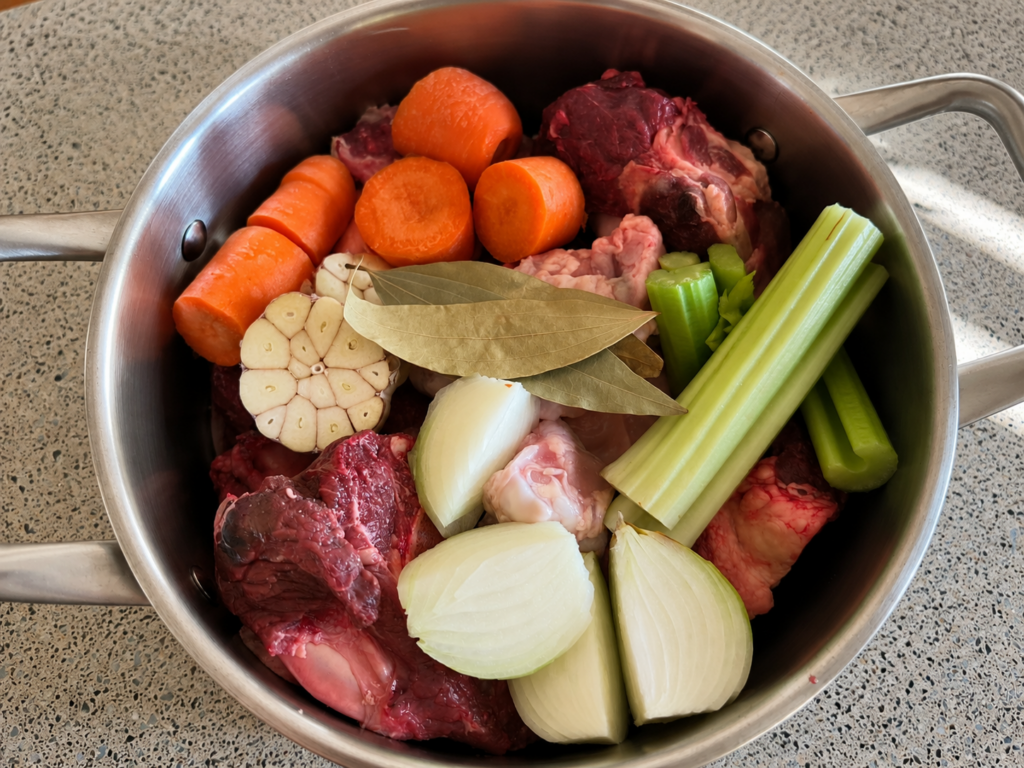
- 500 g chicken frames, necks, wings, or other bone-in chicken pieces
- 400–500 g beef cheek or beef shin (osso buco-style cuts work beautifully)
- 500 g beef soup bones (roughly, 1 or 2 big bones will do!)
- 2 carrots
- 3–4 celery stalks
- 1 brown onion, cut in half
- 1 whole garlic bulb, cut in half crosswise
- 2–3 bay leaves
- 1–2 Parmigiano Reggiano rinds
- Cold water to cover
Optional:
- Salt and pepper to taste for older children and adults
For babies under two years old, I keep this broth very simple and do not add salt or pepper. For younger babies, especially those under 12 months, I prefer an even gentler version made with only a few mild ingredients. I typically use mostly chicken, sometimes with a small piece of beef cheek or veal, along with a carrot, a stick of celery, a potato and 1/4 of a onion in approximately 2 litlre of water. I leave out garlic, herbs, and other seasonings, allowing the delicate flavours of the ingredients to shine through.
Recipe Instructions
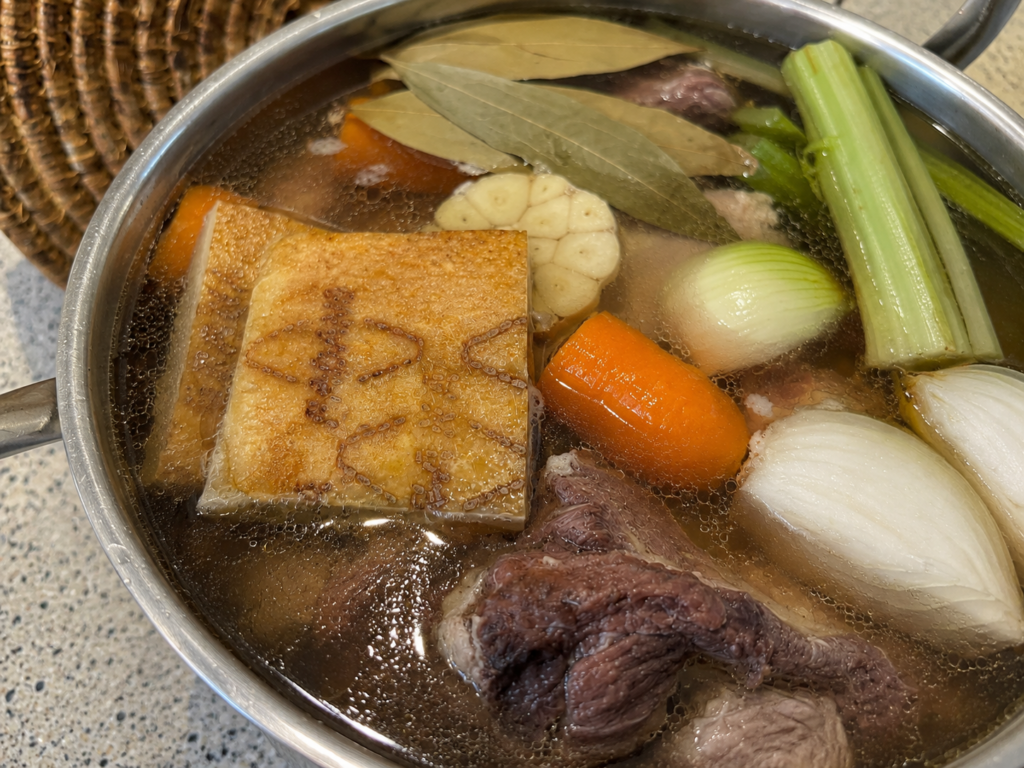
Prepare the ingredients: Rinse and pat dry the chicken pieces, beef cheek (or beef shin), and beef bones. Wash the carrots and celery. Cut the onion and garlic bulb in half. There is no need to peel them, as the broth will be strained later. In fact, leaving the skins on helps add colour and flavour to the final broth.
Add everything to the pot: Place the chicken, beef, bones, carrots, celery, onion, garlic, bay leaves, and Parmigiano rind into a large stock pot. Cover completely with cold water. Starting with cold water is important, as it allows the flavours, minerals, gelatine, and nutrients to slowly infuse into the broth as the temperature rises.
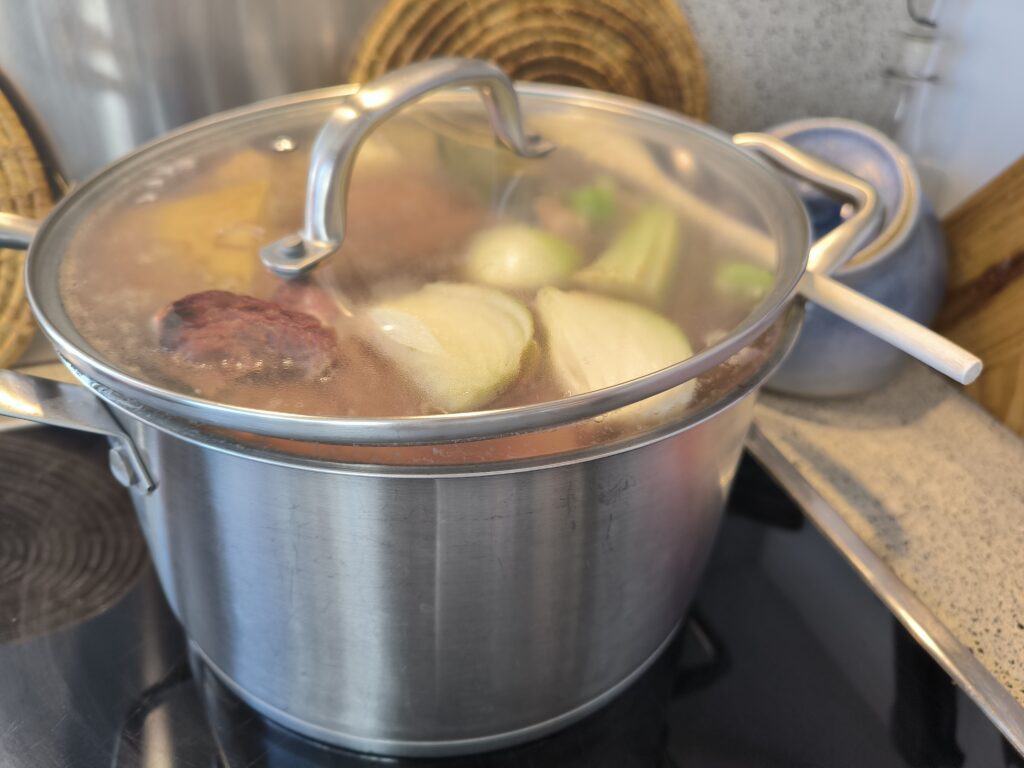
Bring gently to a boil: Place the pot over medium heat and slowly bring everything to a gentle boil. As the broth heats, you may notice some foam and impurities rising to the surface. Simply skim these off with a spoon or ladle. Don’t stress about removing every last bit; this is homemade broth, not a restaurant competition.
Turn the heat down and let time do the work: Once boiling, reduce the heat to low, cover with a lid, and allow the broth to simmer gently.
Now comes the hardest part: doing absolutely nothing.
A good broth needs time. Five hours will create something beautiful. Eight hours will create something even richer, deeper, and more flavourful.
This is one of those recipes where patience really becomes an ingredient.
On study days or rainy days at home, I often put a pot on around 7 am and simply let it quietly bubble away in the background until dinner time.
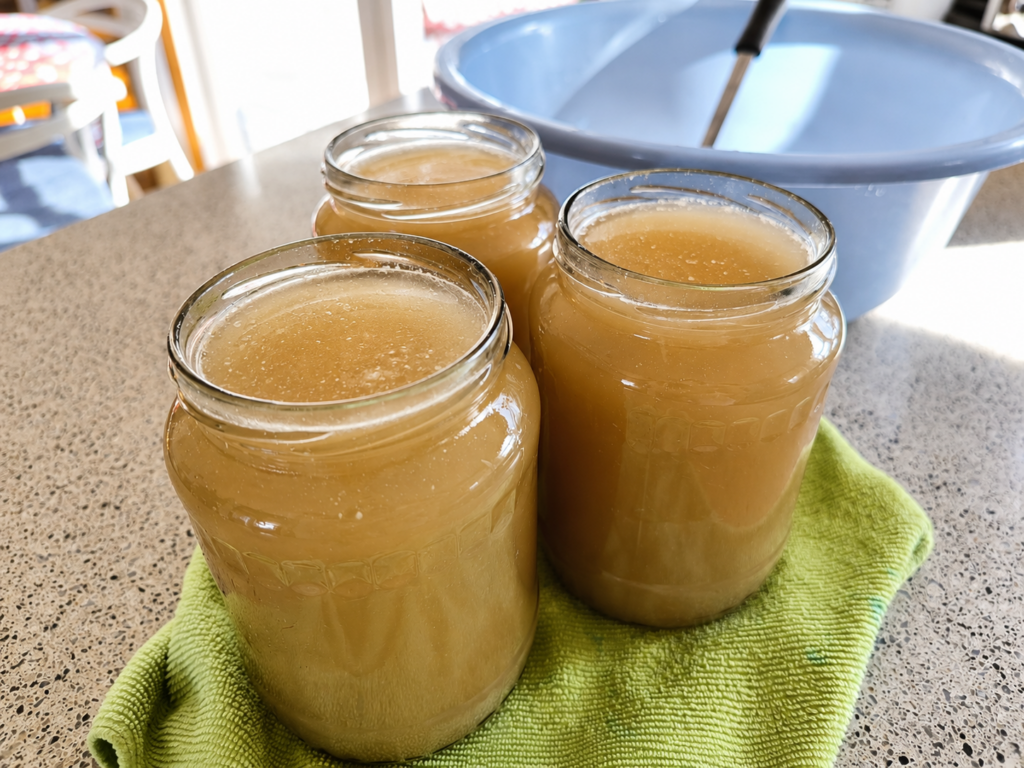
Strain and save: Once the broth is ready, carefully strain it through a fine sieve into a clean pot or large bowl. Remove the vegetables, herbs, and bones. The broth is now ready to use for soups, risottos, pasta dishes, weaning meals, or simply enjoyed on its own.
I also sometimes use homemade broth as the cooking liquid for rice, pastina, or other small pasta shapes. Rather than serving it as a soup, I add just enough broth for the grains or pasta to absorb as they cook, concentrating both the flavor and nourishment in the finished dish.
Don’t forget the meat: One of my favourite things about traditional broth is that the ingredients become a second meal. The beef and chicken used to make the broth can be served warm as a simple secondo, shredded into soups, mixed into sauces, or transformed into meatballs for another day. Nothing is wasted.
Storage: Allow the broth to cool before transferring it to containers. Store in the refrigerator for up to 4–5 days or freeze in portions for future meals. I often freeze small containers specifically for risotto, soups, quick toddler meals, and those inevitable days when someone in the house needs a little extra comfort.
Thank you for spending a little time in my kitchen today.
If you enjoy recipes, family food traditions, and evidence-based nutrition inspired by the first 1000 days and beyond, you can follow along on Instagram or subscribe to Little Brave Celery for future articles and recipes.
Until next time, keep nourishing with curiosity and kindness, one bite at a time! Ciao.
